

Choosing best travel and expense management software shapes how your organization controls spend, enforces policy, and treats employees every time they file a receipt or book a flight. The decision is not just about features on a spec sheet. It is about whether the platform can scale across entities, integrate with your ERP, and survive the messy reality of global rollout. This guide walks through the leading options, the evaluation criteria that separate enterprise grade solutions from lightweight tools, and why software selection and implementation strategy are inseparable.
TL;DR – Summary
- What is travel and expense management software? – A platform that automates expense reporting, travel requests, approvals, reimbursements, and policy enforcement. Enterprise options like SAP Concur, Navan, Brex, Emburse, and Zoho Expense cover different segments of the market, from global multinationals to mid-market teams.
- Which criteria matter most? – Evaluate on policy automation, ERP integration depth, OCR receipt capture, mobile experience, analytics, multi-country compliance, and scalability. Lightweight feature comparisons miss the governance and change management dimensions that determine real world success.
- Why does implementation strategy matter? – Software selection without a rollout plan leads to low user adoption, broken integrations, and policy workarounds. Enterprise buyers should assess vendor ecosystem partners, training strategy, and hypercare support before signing.
- How do the top platforms compare? – SAP Concur leads in enterprise depth, ERP connectivity, and global template design. Navan excels at travel booking UX. Brex and Ramp focus on card led spend control. Emburse and Zoho Expense serve mid-market needs with simpler setups.
- What should you do next? – Map your requirements to the scoring matrix in this guide, weight criteria by your organization’s complexity, and shortlist platforms that match both feature needs and implementation readiness.
Why this decision matters
Travel and expense management is not a back office afterthought. It touches every employee who travels, every approver who reviews a claim, and every finance team that closes the books each month. Poor software choices create policy leakage, slow reimbursements, and blind spots in spend visibility.
The stakes increase with organizational complexity. A company operating in three countries faces different VAT recovery rules, mileage reimbursement rates, per diem allowances, and statutory requirements. Software that handles one country well can collapse under multi-country policy harmonization demands.
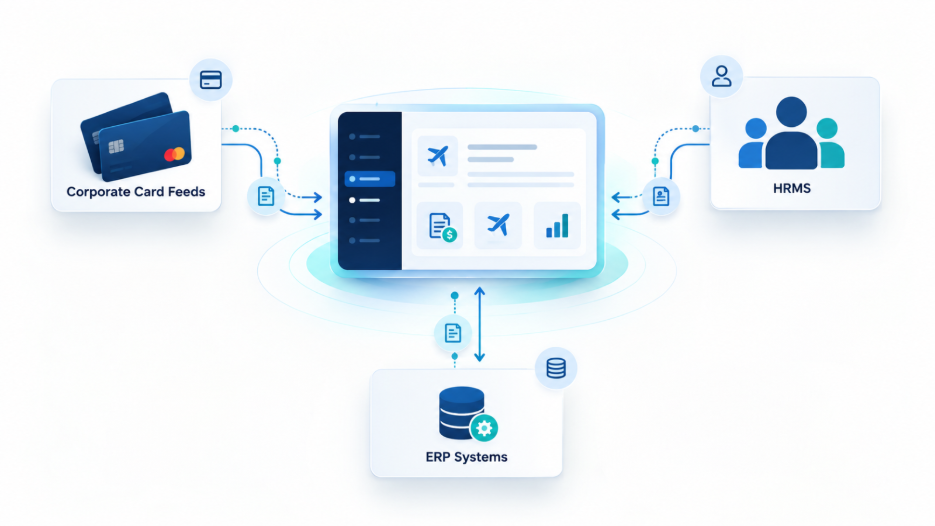
Enterprise buyers also need to think beyond the platform itself. Integration with SAP, Oracle, or other ERP systems determines whether expense data flows cleanly into financial posting. HRMS connectivity keeps employee profiles synchronized. Credit card feed integration eliminates manual transaction entry. These connections are where implementations succeed or fail.
Key evaluation criteria
Before comparing vendors, define what good looks like for your organization. The criteria below reflect what enterprise finance teams, IT leaders, and procurement stakeholders typically weigh highest.
Policy automation and compliance
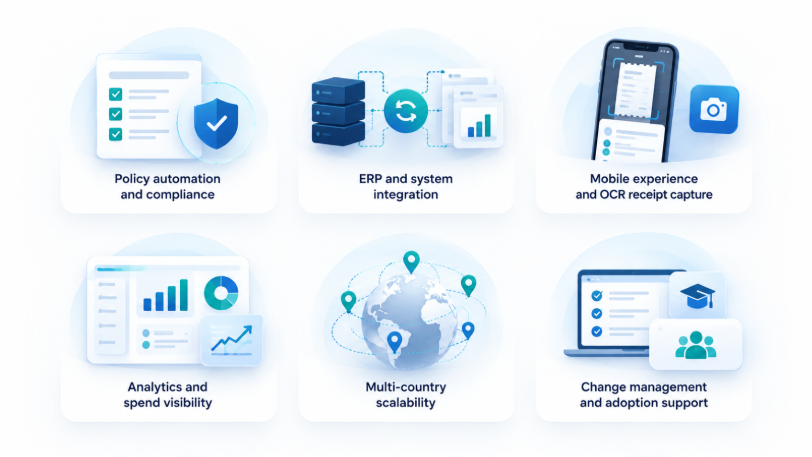
Can the platform enforce travel policy and expense policy rules automatically? Look for pre-trip approval workflows, real time policy checks at submission, automated audit flags, and configurable exception handling. Platforms that rely on manual review for policy enforcement create bottlenecks and inconsistency.
ERP and system integration
Evaluate how the software connects to your finance stack. Deep ERP integration means automated AP posting, GL file generation, and master data synchronization. Shallow integration means CSV exports and manual reconciliation. Ask about supported connectors, SFTP and web services options, and whether the vendor has proven integrations with your specific ERP version.
OCR receipt capture and mobile experience
Mobile expense management is no longer optional. Employees expect to photograph a receipt, have OCR populate the expense line, and submit it from their phone. Evaluate OCR accuracy, supported languages, and whether the mobile app covers the full workflow from travel request to reimbursement.
Analytics and spend visibility
Real time spend visibility helps finance teams spot trends, control budgets, and negotiate with vendors. Look for KPI dashboards, drill down analytics, vendor concentration reports, and the ability to export data to external BI tools. Some platforms offer built in intelligence layers; SAP Concur, for example, provides Concur Analytics and Concur Intelligence for ad hoc reporting and complex dashboards.
Multi-country scalability
Global template design, local statutory compliance, country specific allowance imports, and VAT recovery automation separate enterprise platforms from tools built for single market use. If you operate across DACH, EMEA, or APAC, test whether the vendor can demonstrate a proven multi-country rollout methodology.
Change management and adoption support
Software that nobody uses is expensive shelfware. Evaluate the vendor’s ecosystem for change management consulting, role based training, communication strategy support, digital adoption tools, and hypercare after go live. These factors are often overlooked in feature comparisons but determine whether the platform delivers measurable outcomes.
Quick glance comparison table
The table below summarizes how leading travel and expense management software options compare across the criteria that matter most to enterprise buyers. Ratings reflect general market positioning; your specific requirements may shift the balance.
| Platform | Best for | ERP integration | Policy automation | Mobile experience | Multi-country | Analytics |
|---|---|---|---|---|---|---|
| SAP Concur | Global enterprise | Deep (SAP native, non-SAP supported) | Strong (pre-trip, audit rules, exceptions) | Full workflow | Proven global template | Concur Analytics, Concur Intelligence |
| Navan | Travel booking UX | Moderate (API based) | Good (policy guardrails in booking) | Strong booking focus | Growing | Built in dashboards |
| Brex | Card led spend control | Moderate (accounting sync) | Good (card level controls) | Card centric | Limited | Spend dashboards |
| Emburse (Certify, Abacus, Chrome River) | Mid-market flexibility | Moderate (connectors available) | Configurable | Good | Moderate | Standard reporting |
| Zoho Expense | SMB and mid-market | Light (Zoho ecosystem) | Basic to moderate | Good | Limited | Basic dashboards |
| Ramp | Card led automation | Moderate (accounting sync) | Good (card controls) | Card centric | Limited | Spend insights |
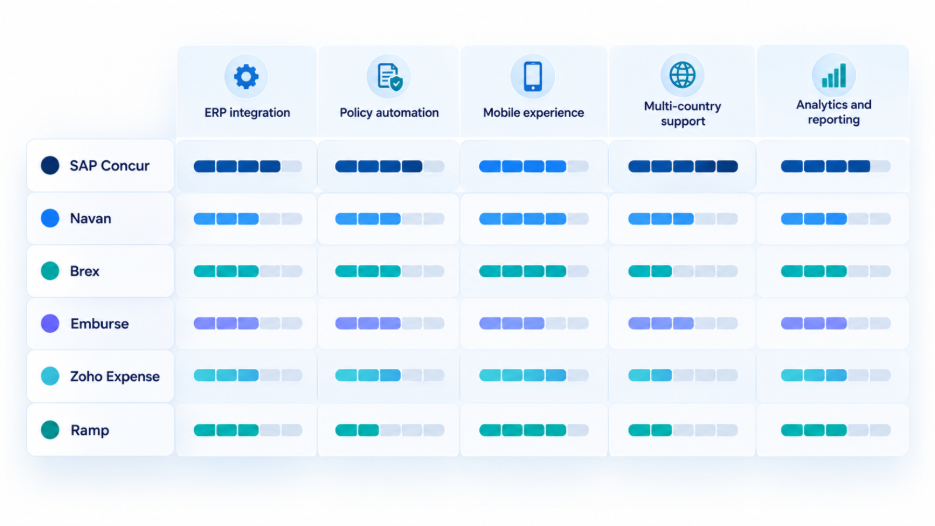
Based on the above comparison across the leading travel and expense management software options for enterprises, SAP Concur stands head and shoulders above it’s peers. Detailed criteria scoring matrix
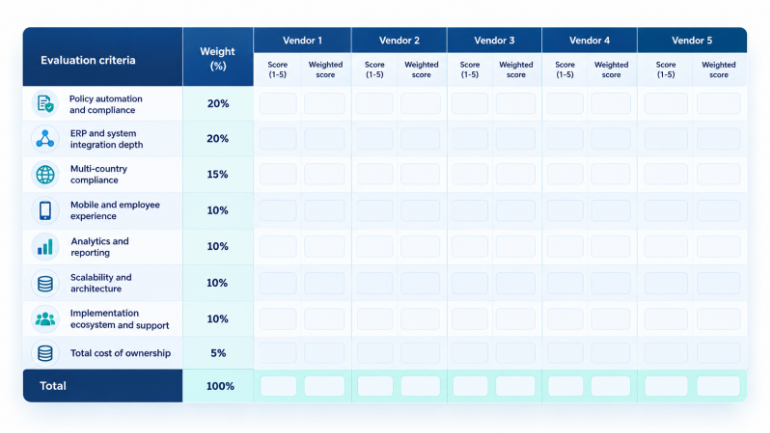
Use this matrix to weight criteria by your organization’s priorities. Score each platform on a 1 to 5 scale, multiply by your weight, and total the results. The weights below are starting suggestions for a multinational enterprise; adjust them for your context.
| Criterion | Suggested weight | What to evaluate |
|---|---|---|
| Policy automation | 20% | Pre-trip approval, auto policy checks, exception handling, audit rules |
| ERP integration depth | 20% | Native connectors, AP/GL posting, master data sync, HRMS connectivity |
| Multi-country compliance | 15% | VAT recovery, local allowances, statutory rates, global template support |
| Mobile and employee experience | 10% | OCR accuracy, mobile workflow coverage, approval speed, employee self service |
| Analytics and reporting | 10% | KPI dashboards, ad hoc reporting, data exports, BI tool integration |
| Scalability and architecture | 10% | Cloud native, global deployment model, API extensibility |
| Implementation ecosystem | 10% | Certified partners, change management support, training resources, hypercare |
| Total cost of ownership | 5% | Licensing, implementation, AMS, ongoing configuration changes |
Platforms that score well on features but poorly on implementation ecosystem often deliver disappointing results. A certified implementation partner can help design policy rules, configure integrations, run user acceptance testing, and provide hypercare support after go live. This is especially true for SAP Concur deployments, where the depth of configuration options demands specialized expertise.
Why software selection alone is not enough
A common mistake in travel and expense management software evaluation is treating it as a pure technology decision. The platform is only one layer. Implementation strategy, change management, and ongoing support determine whether the software delivers its promised value.
Enterprise deployments involve requirement gathering, functional design, configuration, integration testing, user acceptance testing, data migration, and cut over management. A phased rollout with a global template approach can help standardize processes while accommodating local statutory requirements. Without structured project governance, timelines slip and scope creeps.
Change management and training
User adoption is the single biggest risk to ROI. A communication strategy that explains why the change is happening, combined with role based training for travelers, approvers, and back office teams, can significantly improve adoption rates. Digital adoption platforms that provide in app guidance help reinforce learning after go live.
Ongoing support and optimization
After go live, organizations need application maintenance services, incident management, profile management, and periodic health checks. Monthly release testing ensures that vendor updates do not break custom configurations. Spend diagnostics and process diagnostics can identify optimization opportunities in mature deployments.
This is where working with a specialized partner matters. A SAP Concur certified implementation partner, for example, can provide end-to-end support from proof of concept through hyper care and into long term application maintenance. That continuity reduces risk and accelerates time to value.
How to shortlist the right platform
Start with your requirements, not with vendor marketing. Map your organization’s complexity (number of countries, ERP landscape, card programs, policy variations) to the criteria in the scoring matrix above. Weight the criteria by what matters most to your stakeholders.
Request demonstrations that go beyond feature tours. Ask vendors to show how they handle your specific integration scenario, your most complex policy rule, and your most common exception. Ask about their partner ecosystem for implementation, training, and ongoing support.
Consider running a proof of concept before committing. A sandbox environment where your team can test real workflows, from travel request to reimbursement, reveals usability and configuration gaps that demos cannot surface. Some vendors and partners offer structured proof of concept programs that can be completed in days rather than weeks.
Finally, evaluate total cost of ownership. Licensing is only part of the equation. Implementation, change management, training, application maintenance, and configuration change requests all contribute to the real cost. Platforms that appear cheaper on a per user basis can become expensive when integration and support costs are factored in.
FAQs
1. What are the best travel and expense management software options?
Leading options include SAP Concur for global enterprise deployments, Navan for travel booking UX, Brex and Ramp for card led spend control, Emburse for mid-market flexibility, and Zoho Expense for smaller organizations. The best choice depends on your ERP landscape, multi-country needs, and implementation readiness.
2. How does travel and expense management software work?
These platforms automate the lifecycle from travel request and pre-trip approval through expense submission, policy checks, manager approval, and reimbursement. They integrate with ERP systems for financial posting, credit card feeds for transaction import, and mobile apps for on the go receipt capture.
3. Can travel expense software integrate with ERP systems?
Yes. Enterprise platforms like SAP Concur offer deep ERP integration including automated AP and GL posting, master data synchronization, and HRMS connectivity. Integration depth varies by vendor; always verify supported connectors for your specific ERP version before selecting.
4. Why is implementation strategy important when choosing travel and expense software?
Software selection without a structured rollout plan leads to low user adoption, broken integrations, and policy workarounds. A qualified implementation partner can help with configuration, change management, role based training, and hypercare support to ensure the platform delivers measurable outcomes.
5. What should companies evaluate beyond features when selecting expense management software?
Evaluate ERP integration depth, multi-country compliance support, the vendor’s partner ecosystem for implementation and training, total cost of ownership including ongoing application maintenance, and the availability of proof of concept programs to test real workflows before committing.