
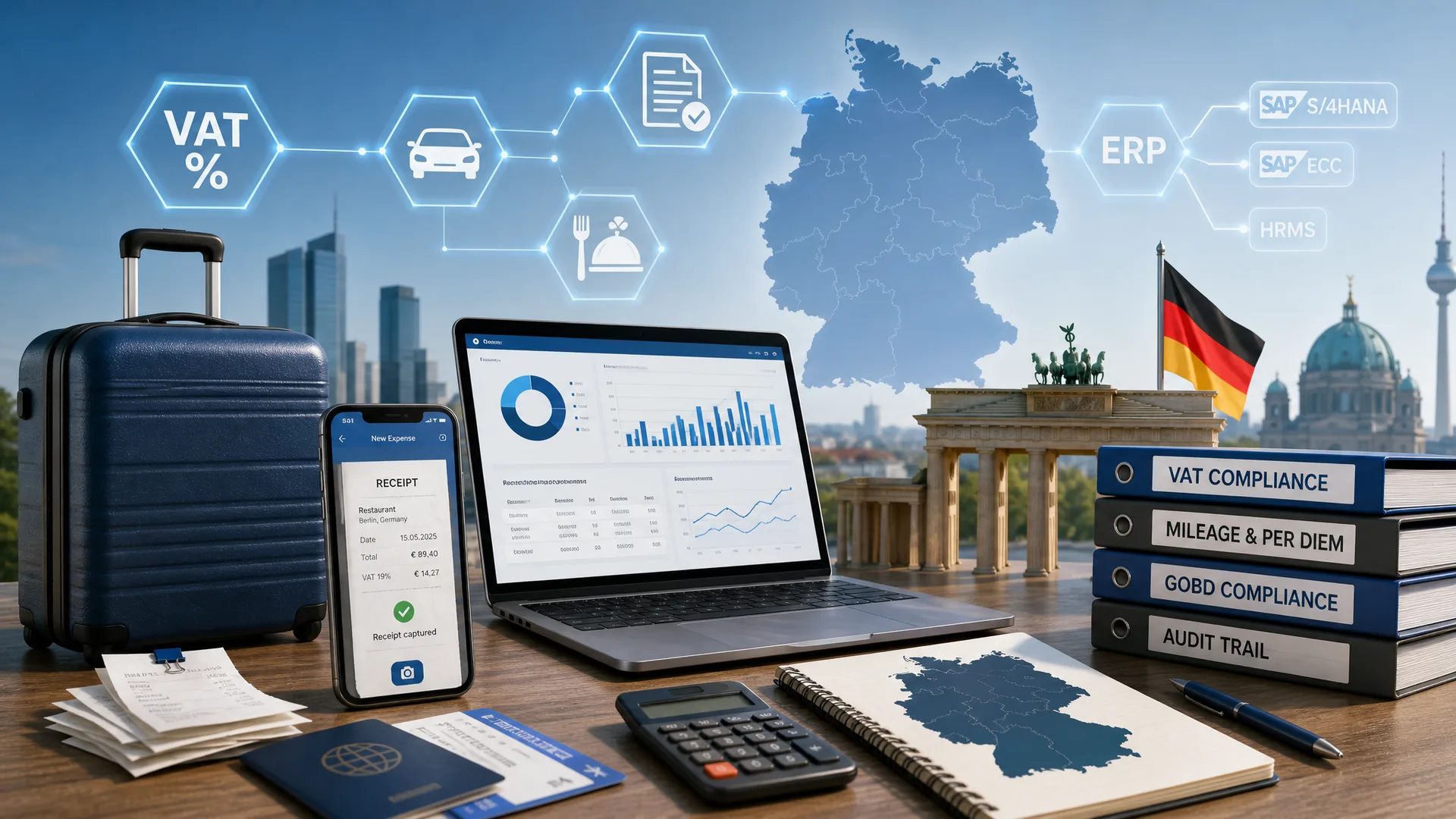
Selecting travel expense management software for a German enterprise is not a generic procurement exercise. Finance leaders, transformation managers, and procurement teams face a unique intersection of VAT compliance, statutory mileage and per diem rules, ERP integration demands, and multi-country policy control that most global buyer guides overlook. FinTrans Solutions, as a specialist SAP Concur partner focused on Germany and the DACH region, helps enterprises evaluate and implement solutions that actually fit local requirements. As a certified SAP Concur Implementation Partner (CIP), FinTrans Solutions brings you this guide to help readers break down the key criteria, compare leading options, and frame the decision around implementation readiness rather than feature lists alone.
Summary
- What makes Germany different? – German enterprises must handle country specific VAT recovery, statutory mileage rates, per diem allowances, and Grundsaetze ordnungsmaessiger Buchfuehrung (GoBD) audit requirements. A travel expense management software that lacks native support for these rules creates compliance gaps and manual workarounds.
- Which platforms lead for German enterprises? – SAP Concur, Yokoy, Circula, and Spendesk are among the most evaluated options. SAP Concur is designed to handle the deepest ERP integration and multi-country policy control scenarios, which is why large enterprises in Germany frequently shortlist it.
- Why does implementation matter as much as features? – Software selection without implementation planning leads to poor user adoption, integration failures, and policy gaps. A specialist Concur partner like FinTrans Solutions can help enterprises assess change readiness, ERP fit, and rollout sequencing before committing to a platform.
- What evaluation criteria should buyers prioritize? – German enterprises should score vendors across VAT handling, ERP and HRMS integration depth, mobile OCR capture, pre-trip approval workflows, multi-country policy harmonization, and post go-live support models.
- How does FinTrans support the buying decision? – FinTrans Solutions offers SAP Concur proof of concept environments, implementation consulting, change management, and application maintenance services tailored to German and DACH region enterprises.
Why Germany needs a localized lens
Global travel expense management platforms often market themselves as ready for any country. In practice, German enterprises encounter friction in several areas that generic solutions handle poorly or not at all.
VAT recovery on business travel expenses in Germany follows specific rules about which expense categories qualify, how receipts must be documented, and how recoverable tax is mapped to financial postings. Software that treats VAT as a flat percentage field rather than a configurable, category aware recovery engine can leave significant money on the table.
Statutory mileage reimbursement rates in Germany differ from those in other European countries. The Pendlerpauschale and business mileage rates for personal versus company vehicles require distinct calculation logic. Per diem allowances (Verpflegungsmehraufwand) follow federal guidelines that change periodically and vary by domestic versus international travel.
GoBD compliance demands expense records be stored in audit ready, tamper proof formats. Any software that cannot produce compliant audit trails, or that allows retroactive editing without version control introduces regulatory risk.
ERP integration is not optional for most German enterprises. SAP S/4HANA, SAP ECC, and other ERP systems are deeply embedded in finance operations. Travel expense management software must post directly to the general ledger, synchronize master data with HR systems, and reconcile corporate card feeds without manual intervention.
Evaluation criteria that matter
Buying committees in German enterprises typically include finance, IT, procurement, and HR stakeholders. Each group cares about different dimensions. The criteria matrix below consolidates the factors that should drive a structured evaluation.
Criteria scoring matrix
|
Criterion |
Why it matters in Germany |
What to test |
Weight (suggested) |
|
VAT recovery automation |
Recoverable VAT on travel expenses can represent meaningful savings; manual processes miss eligible claims |
Category level VAT mapping, automated recovery flagging, country specific tax rules |
High |
|
Statutory mileage and per diem |
German rates are federally defined and must be applied correctly to avoid tax audit findings |
Rate table configurability, automatic updates, domestic versus international logic |
High |
|
ERP integration depth |
SAP environments dominate German enterprise finance; shallow integrations create reconciliation gaps |
Native SAP connectors, bidirectional master data sync, financial posting accuracy, SFTP and web services |
High |
|
Multi country policy control |
DACH and European entities need harmonized policies with local deviations |
Policy rule engine flexibility, country-specific overrides, entitlement rules by entity |
Medium to high |
|
Mobile OCR receipt capture |
Traveling employees need fast, accurate receipt digitization on the go |
OCR accuracy rates, multi-language support, auto populated expense lines |
Medium |
|
Pre-trip approval workflows |
Budget validation before booking reduces out-of-policy spend |
Configurable approval routing, budget checks, travel request to booking integration |
Medium |
|
Corporate card integration |
Card feed reconciliation errors are a top pain point for finance teams |
Automated transaction matching, delayed transaction handling, multi card program support |
Medium |
|
Audit and compliance reporting |
GoBD and internal audit requirements demand tamper proof records and exception reporting |
Audit trail completeness, exception dashboards, report export formats |
Medium |
|
Change management and adoption support |
User adoption failures are the primary reason enterprise rollouts underperform |
Vendor or partner provided training, digital adoption tools, role-based enablement |
Medium |
|
Post go -live support model |
Ongoing functional support, health checks, and release testing keep the system performing |
AMS service levels, incident management SLAs, health check cadence |
Medium |
Leading options compared
German enterprises evaluating travel expense management software typically consider a mix of global platforms and regional specialists. The comparison table below summarizes how the most frequently shortlisted options perform against the criteria that matter locally.
Quick glance comparison table
|
Capability |
SAP Concur |
Yokoy |
Circula |
Spendesk |
|
German VAT recovery |
Configurable category level VAT mapping with recovery automation |
AI driven VAT detection; growing coverage |
Strong statutory compliance |
Basic VAT handling; less depth for complex recovery |
|
Statutory mileage and per diem |
Supports German rates with configurable rate tables |
Supports German per diem and mileage |
Native German per diem and mileage calculation |
Limited per diem support for Germany |
|
ERP integration (SAP) |
Native SAP connectors; deepest integration for S/4HANA and ECC |
API-based; requires middleware for deep SAP integration |
API based; limited native SAP depth |
API based; not SAP native |
|
Multi country policy engine |
Enterprise grade; supports global templates with local overrides |
Growing multi-country support |
Primarily DACH focused |
European focus; less enterprise depth |
|
Mobile OCR capture |
Mature mobile app with OCR and auto population |
AI powered OCR with high accuracy |
Mobile OCR with German receipt optimization |
Mobile OCR available |
|
Pre trip approval |
Full travel request to booking workflow |
Available but less mature |
Limited pre trip workflow |
Not a core feature |
|
Corporate card integration |
Broad card program support with automated feeds |
Card feed integration available |
Corporate card support available |
Strong card management; Spendesk issues its own cards |
|
Enterprise scale |
Designed for large, multi-entity, multi country enterprises |
Mid-market to enterprise |
SME to mid-market |
SME to mid-market |
|
Implementation partner ecosystem |
Certified partners like FinTrans provide localized implementation |
Direct vendor implementation |
Direct vendor implementation |
Direct vendor implementation |
This comparison is not exhaustive, and every enterprise should validate vendor’s claims against its own requirements. The table reflects publicly available information and common evaluation patterns observed in German enterprise buying cycles.
Why SAP Concur leads for large German enterprises
For enterprises running SAP ERP environments, SAP Concur is designed to offer the deepest native integration. Financial postings, master data synchronization, corporate card reconciliation, and HRMS connectivity can be configured without middleware in many scenarios. This reduces integration risk and ongoing maintenance overhead.
SAP Concur’s policy engine supports global template design with controlled local deviations. A German entity can enforce domestic per diem rates and VAT rules while sharing a common approval workflow and reporting structure with entities in Austria, Switzerland, or beyond.
The platform’s reporting layer, including Concur Analytics and Concur Intelligence, provides spend visibility dashboards, KPI tracking, and drill down analysis that finance leaders in Germany expect. Advanced reporting can feed external BI tools through scheduled data exports.
Where SAP Concur’s strength becomes most apparent is in complex, multi country rollouts where policy harmonization, change management, and phased deployment matter. This is also where the choice of implementation partner can determine whether the platform delivers on its potential.
Implementation realities in Germany
Software features alone do not predict success. German enterprises that treat travel expense management software selection as a technology decision without addressing implementation realities often face poor user adoption, integration failures, and compliance gaps after go-live.
Policy configuration and localization
Configuring expense policies that reflect German statutory requirements while aligning with a global policy framework requires deep knowledge of both the platform and local regulations. Per diem rates, mileage calculation logic, receipt requirements, and audit rules must be set up correctly from the start. Errors in policy configuration are a common source of post go-live support tickets.
ERP integration planning
Integration between SAP Concur and SAP S/4HANA or ECC requires careful mapping of chart of accounts, cost centers, financial posting rules, and master data flows. Bidirectional data synchronization between the expense platform, ERP, and HRMS must be validated through integration testing before go-live. FinTrans Solutions specializes in configuring these connections for German enterprises, including ICS native integration and SFTP based file transfers.
Change management and user adoption
Resistance to new expense processes is common, especially when employees are accustomed to manual or spreadsheet-based workflows. A structured change management approach, including stakeholder engagement, role-based training for travelers, approvers, and back-office teams, and a communication strategy, can help improve adoption rates. FinTrans provides change management consulting that addresses these challenges specifically for SAP Concur rollouts in Germany.
Hypercare and ongoing support
The weeks immediately after go-live are critical. Hypercare support helps stabilize workflows, resolve user issues quickly, and address configuration gaps before they become entrenched. Beyond hypercare, ongoing application maintenance services (AMS) provide functional support, incident management, health checks, and release testing. FinTrans offers AMS services for SAP Concur environments in Germany, including Level 1 through Level 3 support.
What buying committees should ask
Enterprise buying committees evaluating travel expense management software for Germany should go beyond feature checklists. The following questions can help surface the implementation and compliance realities that determine long term success.
- How does the platform handle German VAT recovery at the expense category level?
- Can statutory mileage and per diem rates be updated without custom development?
- What native SAP ERP connectors are available, and is a middleware required?
- How does the policy engine support local German rules within a global template?
- What is the vendor’s or partner’s track record with German enterprise rollouts?
- What change management and training support is included or available?
- What does the post go live support model look like, and what SLAs apply?
How FinTrans Solutions supports the decision
FinTrans Solutions is an SAP Concur certified implementation partner with deep expertise in the DACH market. FinTrans Solution helps enterprises evaluate whether SAP Concur fits their specific requirements, and then delivers the implementation, change management, and ongoing support needed to make it work.
FinTrans Solutions can provide an SAP Concur proof of concept environment so that buying committees can test workflows, policy rules, and integrations against real scenarios before committing. This proof-of-concept approach is designed to reduce implementation risk by validating fit early.
For enterprises already running SAP Concur, FinTrans Solutions offers Concur Instance Health Checks, process diagnostics, spend diagnostics, and optimization reviews to identify gaps and improvement opportunities in existing configurations.
Whether an enterprise is selecting travel expense management software for the first time or reevaluating an underperforming implementation, FinTrans Solutions brings the Germany specific compliance knowledge, ERP integration expertise, and change management capability that generic consultancies often lack.
Choosing travel expense software for a German enterprise is a decision that touches finance, IT, HR, and procurement. The right platform must handle VAT, statutory rates, ERP integration, and multi-country policy control natively. But the right implementation partner is what turns a software purchase into a working system. FinTrans Solutions is designed to be that partner for SAP Concur decisions in Germany.
FAQs
1. What are the best travel expense software options for enterprises in Germany?
SAP Concur, Yokoy, Circula, and Spendesk are among the most evaluated options. SAP Concur is designed to offer the deepest ERP integration and multi country policy control for large German enterprises, especially those running SAP environments. FinTrans can help evaluate fit through a proof of concept.
2. Does travel expense software help with VAT recovery in Germany?
Yes. Platforms like SAP Concur support category level VAT mapping and automated recovery flagging for German travel expenses. Proper configuration is essential; a specialist partner like FinTrans can help ensure VAT rules are set up correctly for maximum recovery.
3. Can travel expense software integrate with SAP ERP systems?
SAP Concur offers native connectors for SAP S/4HANA and ECC, enabling direct GL posting, master data synchronization, and corporate card reconciliation. Other platforms typically require API based middleware. FinTrans specializes in configuring these integrations for German enterprises.
4. How long does SAP Concur implementation take for a German enterprise?
Implementation timelines vary based on scope, number of entities, and integration complexity. A single country deployment may take several months, while multi country rollouts can span longer. FinTrans helps enterprises plan phased deployments that manage risk and support user adoption.
5. Why is change management important when deploying travel expense software?
Poor user adoption is the most common reason enterprise expense rollouts underperform. Structured change management, including stakeholder engagement, role based training, and communication planning, can help improve adoption. FinTrans provides change management consulting tailored to SAP Concur projects in Germany.